

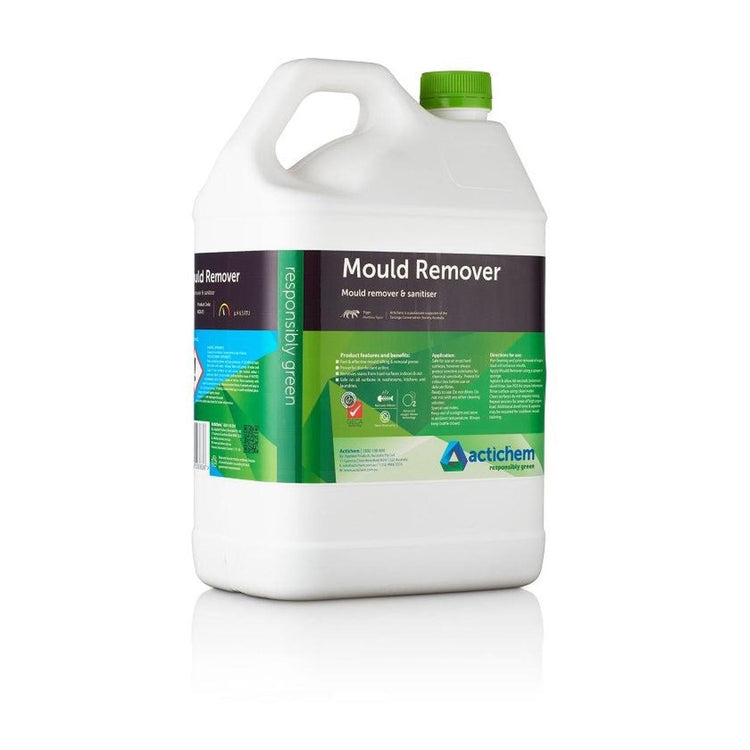

Product Overview
Actichem Mould Remover is a peroxide-based product for removing mould and mildew and the staining they leave behind, formulated for washrooms, change rooms and locker rooms.
Its main practical advantage is what it is not: it is not a hypochlorite bleach. That matters more than it sounds — see below.
Peroxide, not bleach — and why that matters
Most mould products reach for sodium hypochlorite. Actichem Mould Remover uses hydrogen peroxide (under 5%) instead. Three practical consequences:
- It is safe on natural stone. This is the big one. Bathrooms are full of marble, limestone and travertine, and hypochlorite products — usually strongly alkaline — are a poor match for them. Mould Remover is mildly acidic and does not carry that risk.
- It does not produce chlorine odour, which is the usual complaint after a bathroom mould treatment in an occupied building.
- It will not form chloramine gas if it meets an ammoniated cleaner. Bathrooms are exactly where that accident happens, because ammoniated glass and washroom cleaners live in the same trolley as bleach.
That last point is a genuine safety advantage over a bleach-based mould product. It does not mean you should mix it with anything — see the safety section — but it removes one of the more common ways cleaners are injured.
Benefits
- Removes mould, mildew and the staining they leave.
- Fast — 60 seconds minimum dwell, with longer dwell for stubborn staining.
- Safe on natural stone — unlike most hypochlorite mould products.
- Suitable for hard surfaces in washrooms, laundries and kitchens.
- Non-flammable.
A note on what we do and do not claim
This listing previously described Mould Remover as leaving surfaces “germ-free”, as a “high-performance sanitiser”, and as providing “sanitisation”. We have removed that wording.
Terms like sanitiser, disinfectant and germ-free are regulated in Australia, and we can find no ARTG or APVMA listing for this product. Hydrogen peroxide is a genuine and effective oxidiser against mould and organic contamination — that much is chemistry, and the product does what it says on mould — but we are not prepared to make a regulated efficacy claim we cannot evidence. We have asked Actichem whether a listing exists. If one does, we will publish it and quote the number.
The existing caveat on this page remains true and is worth repeating: this product is not suitable for use as a disinfectant in medical institutions.
Application areas and surface suitability
Suitable for most hard surfaces in washrooms, laundries and kitchens, including natural stone.
Always pre-test sensitive substrates for chemical sensitivity, and pre-test for colour loss before use on delicate fibres.
How to Use
Read the safety data sheet before use. Pre-test in an inconspicuous location.
Dilution
Ready to use. Do not dilute. Do not mix with any other cleaning solution.
Application
- Pre-clean and remove organic load first. This is the step that determines the result. Peroxide is consumed by whatever organic matter it meets, so applying it over soap scum and body soil spends the active on the soil rather than the mould.
- Apply with a sprayer or sponge.
- Agitate and allow 60 seconds minimum dwell time.
- Rinse the surface with clean water.
- Repeat for areas of high organic load. Stubborn mould staining may need additional dwell and agitation.
⚠ Removing mould is not the same as fixing mould
Worth saying to the customer, because it prevents the callback: mould grows where there is moisture. Cleaning it off treats the symptom. If the ventilation, the leak or the condensation problem is not addressed, it returns — usually within weeks in a bathroom.
Where mould is extensive, recurring, or in a residential property following water damage, it is a remediation job with an assessment and a moisture strategy, not a cleaning job with a stronger product.
Safety
The classification of this product has changed, and this page has been updated to match the current safety data sheet.
Actichem’s safety data sheet for RG615, version 1.3 issued 16 February 2026, records Mould Remover as a non-hazardous chemical and non-dangerous goods under the WHS Regulations and the ADG Code. No GHS classification, no signal word, no hazard statements, no poisons schedule. Actichem confirmed in writing on 9 November 2026 that this sheet is current.
What changed. The 2021 sheet (version 1.1) classified Mould Remover DANGER with H315 and H318 and Poisons Schedule 5, and earlier versions of this page published that classification. Version 1.3 removes the classification entirely. The declared composition is unchanged — hydrogen peroxide under 5% — so as far as we can tell this is a reclassification by Actichem rather than a reformulation. If you hold this product on a chemical register or in a SWMS as a hazardous chemical, update the record against SDS version 1.3.
⚠ The label may still carry a hazard warning
Actichem confirmed in writing on 9 November 2026 that the hazard warning on the current Mould Remover label is to be removed so the label matches the non-hazardous SDS. Stock already in the field, and stock on our shelf, may still carry the old label. Where the label and the SDS disagree, the SDS is the controlled document.
Eye protection is still sensible
Non-hazardous does not mean careless. This product is sprayed, in bathrooms, often at or above head height, at tiled and reflective surfaces — the geometry most likely to put product in an eye. The SDS says personal protection is not normally required and to follow the label. Our practical advice is to wear safety glasses when spraying overhead, and to flush the eye thoroughly with water if contact occurs.
⚠ Do not mix it with anything
Actichem’s sheet records incompatible materials as “none known”. We do not think that is complete for a peroxide product, and we have raised it with them. As a working rule:
- Never mix it with a hypochlorite or bleach product. Even though this product is not itself a bleach, adding it to one is not something to experiment with in a small enclosed bathroom.
- Never mix it with an ammoniated cleaner.
- Do not seal it in a non-vented container. Peroxide solutions decompose slowly and release oxygen, which builds pressure in a sealed vessel.
Ventilation and personal protective equipment
Bathrooms are small, enclosed and poorly ventilated by design. Run the exhaust fan and open a window before you start, not after the smell becomes noticeable. Safety glasses when spraying overhead.
First aid
Eyes. Flush thoroughly with water. Seek medical attention if irritation persists.
Skin. Remove contaminated clothing and flush with running water and soap. Seek medical attention if irritation develops.
Inhalation. Move to fresh air if symptoms develop.
Swallowed. If you feel unwell, seek medical advice or contact the Poisons Information Centre on 13 11 26.
Specifications
| Product code | RG615.05 |
| Pack size | 5 litres |
| Product type | Peroxide-based mould and mildew remover for hard surfaces |
| Appearance | Clear colourless liquid |
| Odour | Mild chemical |
| Dilution | Ready to use — do not dilute |
| pH | 4.6 (Actichem SDS v1.3) — mildly acidic, which is what makes it safe on natural stone. This listing previously stated 7, then 4 – 6. Actichem confirmed in writing on 9 November 2026 that SDS v1.3 is current. |
| Key components | Hydrogen peroxide under 5%; remaining components declared trade secret |
| WHS classification | Non-hazardous chemical (SDS v1.3). Classified DANGER on the 2021 sheet — see Safety |
| Signal word | None |
| Hazard statements | None |
| Poisons schedule | None applicable |
| Dangerous goods | Not regulated for transport |
| Not suitable for | Use as a disinfectant in medical institutions |
| SDS referenced | Version 1.3, issued 16 February 2026 — confirmed current by Actichem in writing, 9 November 2026 |
Related Products
- Actichem Surface Clean HD — heavy duty alkaline hard surface cleaner for pre-cleaning organic load. Do not mix the two — use them as separate steps with a rinse between.
- Actichem Spray n Wipe — general washroom and hard surface cleaner.
Safety Data Sheet
Actichem Mould Remover safety data sheet (RG615, version 1.3, 16 February 2026)
Actichem confirmed in writing on 9 November 2026 that this is the current Australian SDS.
What we see in the field
A black mark in a shower is sometimes just on the surface; sometimes it's coming from a leaking wall behind it. Mould Remover can clean the accessible face, but the same mark returning is a reason to investigate moisture, not to sell another bottle. Don't call a cosmetic clean structural remediation.
SKU: RG615.05
Dealing with recurring mould rather than surface mould? Talk to us. Extensive or repeat mould, particularly after water damage, needs a moisture assessment and a remediation approach — and we would rather point you at the right process than sell you product that will not fix it.


